
2025 ended with a financial and legal wakeup call for CEOs
Few CEOs know much about their company’s healthcare plans. The oldest among us are on Medicare (which doesn’t mean being old these days), many have concierge doctors, and few worry much about their own deductibles or co-pays. For many chief executives, healthcare is a distraction better left to their HR department.
In 2025, that reality shifted dramatically. Not only did companies get hit with double-digit increases in their healthcare spend, but the legal landscape fundamentally changed. A wave of employee class-action lawsuits and federal regulatory actions under ERISA have slammed the directors and officers (D&Os) of major corporations. The charge? Failure to perform their fiduciary duties in safeguarding the finances of employees, who are getting creamed by rising premiums and out-of-pocket costs.
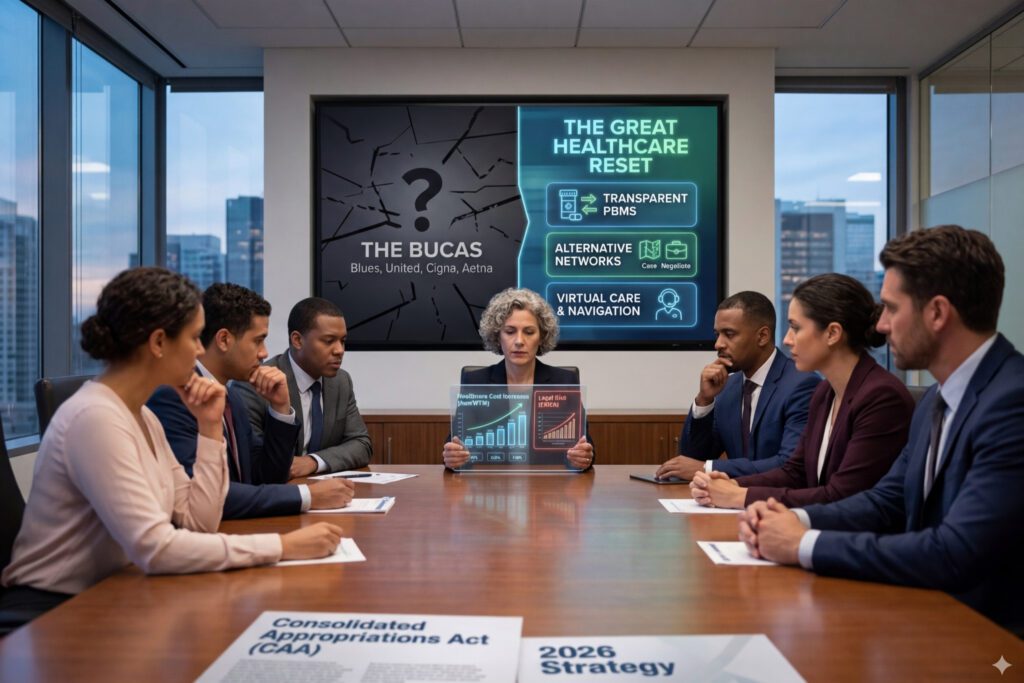
2026 is the year CEOs must get reacquainted with how their companies buy healthcare. Aon, Willis Towers Watson, and Mercer are forecasting the highest cost jumps in 15 years—routinely hovering above 9%. In summarizing recent surveys of employer strategies, McKinsey notes that a record number of companies are finally ready to explore alternatives to traditional, large-carrier health plans—the so-called “BUCAs” (Blues, United, Cigna, Aetna).
Moving Beyond the BUCAs: The 2026 Playbook
For decades, the standard corporate healthcare strategy was simple: HR meets with the broker, the broker brings a renewal from a BUCA, you swallow a 6% to 9% increase, maybe they tell you they saved the day by shaving another point or two, then you shift a little more of the burden onto your employees’ deductibles, and finally, you can get back to business.
Today, thanks to the Consolidated Appropriations Act (CAA) and the resulting wave of ERISA lawsuits, that passive approach is officially a breach of fiduciary duty. Plaintiffs’ attorneys are actively using new transparency rules to prove that employers are overpaying for healthcare and mismanaging employee funds.
To protect their balance sheets and their directors and officers, CEOs are finally doing what they should have done years ago: treating the healthcare supply chain with the same ruthless scrutiny they apply to everything else.
When you look outside the traditional BUCA ecosystem, three distinct alternatives are capturing the C-suite’s attention in 2026:
The Rise of the Transparent PBM (Killing “The Spread”)
Pharmacy costs now account for a massive, disproportionate chunk of employer healthcare spend, driven heavily by specialty drugs. For years, the “Big 3” Pharmacy Benefit Managers (PBMs)—which control 80% of the market—have operated in a black box, utilizing “spread pricing” (charging the employer more than they pay the pharmacy), pocketing manufacturer rebates, and often fleecing employees with co-pays that exceed the cost of the medication they’re buying.
In 2026, fed-up employers and regulators are forcing a shift. The Department of Labor recently proposed aggressive new rules forcing PBMs to disclose hidden fees, and companies are already voting with their wallets. Record numbers of employers are firing legacy PBMs and carving out their pharmacy benefits to “pass-through” or transparent PBMs. These modern vendors charge a flat administrative fee and return 100% of the drug rebates and discounts directly back to the employer and the employee.
Next-Generation Self-Funding & Alternative Networks
If you are fully insured, you are essentially renting a BUCA’s network and paying a massive premium for the privilege, with zero visibility into your actual claims data. To escape this, mid-market companies have been migrating to self-funded or level-funded models at an unprecedented rate.
But they aren’t just self-funding; they are embracing innovative new models. By using independent Third-Party Administrators (TPAs), employers are plugging in alternative networks or are shedding networks altogether, moving to cash pay systems, Reference-Based Pricing (RBP) models, direct contracts, and case-by-case negotiation.
Fixing the “Front Door” with Virtual Care
Traditional insurance makes accessing a primary care doctor expensive and time-consuming, meaning employees often wait until a minor issue becomes a catastrophic, high-dollar ER visit. To combat this, companies are bypassing the insurance middleman entirely for everyday care. They are contracting directly with subscription-based telehealth services that have moved well beyond the first generation of transactional telemedicine (e.g., Teladoc) to comprehensive, relationship-based services that provide holistic and coordinated patient care and navigation.
By paying a flat monthly subscription fee per employee, workers get unlimited, zero-copay access to medical and mental health providers along with a team of navigation and care coordination experts. It removes the financial friction for the employee and drastically reduces downstream specialist and hospital claims for the employer.
The Bottom Line for the C-Suite
Healthcare is no longer just an HR line item; it is a critical matter of supply chain management, corporate governance, and risk management.
Companies that make the moves that are available to them are looking at a one-time “reset” in their baseline healthcare spending, likely to deliver a 20% to 40% reduction in cost. After resetting the baseline, the goal is to manage and contain annual increases like every other expense of the business.
In 2026, the CEO’s job isn’t to pick the health plan. The CEO’s job is to walk into the next executive meeting and ask the CFO and CHRO three simple questions: Are we fully self-funded? Are we using a transparent, pass-through PBM? And are we pursuing a next-generation health plan design? And if the answer to any of those questions is ‘no,’ then they must ask, what is our timeline to get there?
Contributor:

David Silverstein
Email:
authors@the-ceo-magazine.com
LinkedIn:
linkedin.com
Website:
http://www.amazehealth.com/
David Silverstein is a strategist, author, and healthcare innovator dedicated to transforming the American healthcare system. He is the Founder and CEO of Amaze Health, a company focused on empowering employees and individuals to become informed healthcare consumers through education and virtual medical services.

