
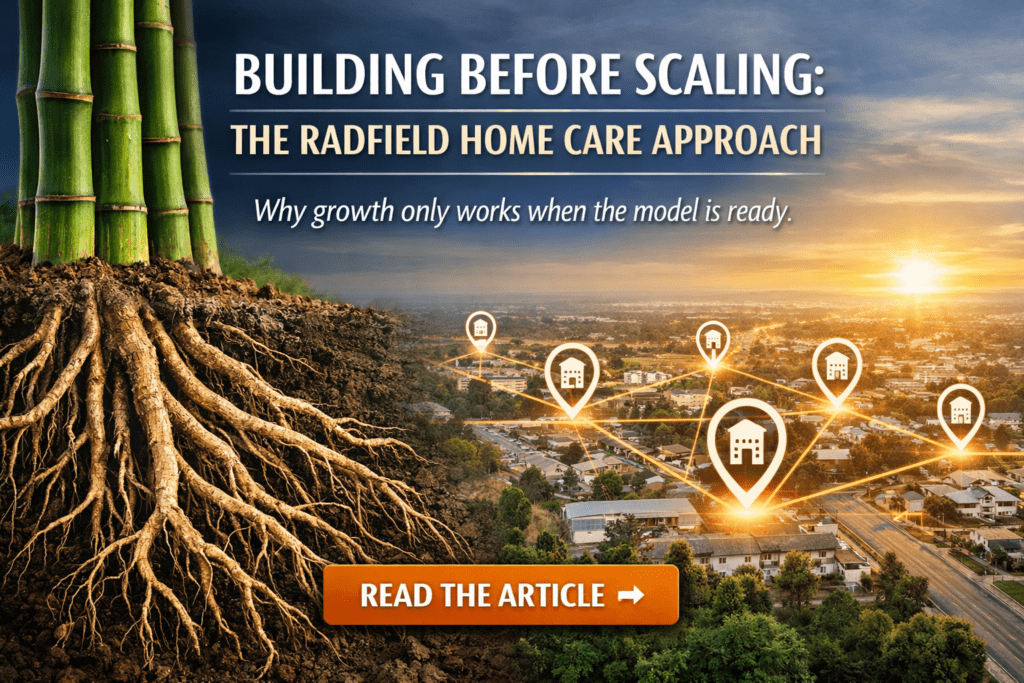
In an environment where expansion is often treated as proof of success, restraint is rarely seen as strategy. Yet in sectors where trust, consistency, and human outcomes matter, premature growth does not create advantage—it amplifies inconsistency.
Radfield Home Care took a different path.
For nearly a decade, before scaling through franchising, the business focused on something less visible and far less celebrated: understanding the model. What appears today as steady, credible expansion is built on years of deliberate learning—an approach that resembles the often-cited Chinese bamboo tree, which spends years developing roots before any visible growth occurs.
The result is not simply a growing network. It is a system designed to deliver care predictably, at scale, without diluting what makes it valuable in the first place.
A Business That Was Not Invented, But Evolved
Radfield’s origins do not lie in a startup insight or a market gap discovered through analysis. They trace back to 1982, when a residential care home was established by the founders’ parents.

For Dr Hannah MacKechnie and Alex Green, the business was not an abstraction. It was an environment they grew up in—shaped by daily exposure to residents, carers, and the realities of care delivery.
Both initially pursued independent paths—Hannah in medicine as a GP, Alex across financial services and the charitable sector. Their eventual return to the family business was not inevitable. It emerged at a point of transition, when succession planning raised a more fundamental question: what should this business become next?
At that moment, the obvious path was expansion within the existing model—growing the residential care footprint. But a closer look at the market revealed a shift already underway. Increasingly, people did not want to move into care settings. They wanted to remain at home.
That single shift—less about industry structure and more about human preference—reframed the opportunity.
Instead of scaling care homes, they chose to build a home care business.
It was a lower-capital decision. It was faster to start. But more importantly, it aligned with where the market—and the expectations of families—were moving.
The Invisible Years: Where the Model Was Built
Radfield Home Care formally began its journey in 2008. What followed was not rapid expansion, but controlled exposure.

Over the next nine years, the business grew to four company-owned locations, all within a manageable geographic radius. This was not a footprint designed for scale. It was a footprint designed for learning.
Home care, unlike residential care, introduces a different set of operational realities. Care is delivered in dispersed environments. It cannot be directly observed. It relies heavily on coordination, logistics, and—most critically—the judgment and behavior of individuals working independently in clients’ homes.
In other words, it is as much a people and systems challenge as it is a care challenge.
Those early years forced the business to confront variation:
- Different local authority dynamics
- Different client expectations
- Different workforce conditions
- Different operational constraints
Mistakes were made. Processes were refined. Assumptions were tested and often disproven.
In hindsight, this period can be described as an apprenticeship. At the time, it was simply the work required to understand what actually drives quality in a decentralized care model.
This distinction matters.
Many businesses attempt to scale what they believe works. Radfield focused first on verifying what actually works—under different conditions, with different people, across multiple environments.
Only after this phase did a more strategic question emerge: Can this be replicated by others?
Choosing to Franchise—But Only When It Could Be Taught
By the mid-2010s, franchising was not an unfamiliar concept in the sector. Other providers—particularly international brands—were already expanding through franchise models in the UK.
Radfield had been aware of this earlier. The option to franchise existed well before 2017. But awareness is not readiness.
Franchising introduces a fundamental shift. The business is no longer defined by what the founders can operate directly. It is defined by what others can execute consistently.
That requires more than a functioning operation. It requires:
- Clearly defined processes
- Transferable standards
- Predictable outcomes
- The ability to train, support, and align independent operators
In short, it requires a model that can be taught—not just performed.
Radfield’s decision to delay franchising until that model had been developed reflects a specific kind of discipline. It prioritizes reproducibility over speed.
When franchising was formally launched in 2017, it was not an experiment in growth. It was an extension of a system that had already been tested in multiple contexts.
What the Model Actually Consists Of
The strength of any franchise system lies in what is being transferred. In Radfield’s case, the model operates across three interconnected layers.
1. Care as Connection, Not Just Delivery
At the client level, the business is not positioned around tasks. While practical support—personal care, daily assistance, routine services—is essential, it is not the defining feature.
The defining feature is connection.
Radfield’s “Be There” philosophy reflects a broader view of care: supporting individuals to remain engaged, connected, and able to live well at home. This shifts the focus from completing activities to enabling quality of life.
It is a subtle but important distinction. One treats care as a series of actions. The other treats it as a relationship.
2. The Workforce as the Core Constraint
In home care, quality is not primarily determined by systems. It is determined by people.
Recognizing this, Radfield places disproportionate emphasis on carers themselves. The principle of “Caring for our Carers” is not simply cultural—it is structural.
Retention, consistency, and engagement among carers directly affect:
- Continuity for clients
- Trust with families
- Stability of operations
In a sector where workforce churn is common, this becomes a competitive advantage.
3. A Franchise System Designed for Execution
At the franchise level, the model is not built for highly autonomous entrepreneurs seeking to reinvent the business. It is built for operators who can take a defined system and execute it effectively within a local context.
This introduces an intentional tension:
- Enough structure to ensure consistency
- Enough flexibility to adapt to local conditions
Franchise partners are expected to build teams, develop relationships, and grow their businesses—but within a framework that has been deliberately constructed.
The system is not designed to be modified at will. It is designed to be applied.
Growth That Followed the Model
Since launching its franchise network in 2017, Radfield has expanded to approximately 30 operating locations, with additional offices in development.
These numbers, on their own, are not exceptional in a sector with multiple franchise providers. What differentiates them is the sequence.
Growth followed model maturity—not the other way around.
This sequencing reduces a common risk in franchising: scaling inconsistency. When expansion outpaces understanding, variability increases, and quality becomes difficult to control.
By contrast, a model that has been refined before scaling is more likely to produce consistent outcomes across locations.
The Discipline of Saying No
One of the less visible aspects of franchising is selection.
Demand for franchise opportunities can create pressure to accept candidates who meet financial criteria but may not align operationally or culturally. Radfield has chosen to resist that pressure.
This manifests in two ways:
- A selective recruitment process
- A willingness to challenge or test candidates before acceptance
The underlying principle is straightforward: growth is constrained not by interest, but by alignment.
This approach may limit the speed of expansion. It also reduces the likelihood of misalignment within the network—a factor that becomes increasingly costly as the system grows.
The Tensions That Remain
No model eliminates tension. It manages it.
Radfield’s current operating environment continues to be shaped by a set of ongoing trade-offs:
- Growth vs. Quality
Expanding the network while maintaining consistent standards - Autonomy vs. Consistency
Allowing franchise partners to operate locally without fragmenting the model - Recruitment vs. Selectivity
Attracting sufficient candidates while maintaining strict entry criteria
These are not temporary challenges. They are structural features of the model.
Looking Ahead: Pressure and Positioning
The broader environment introduces additional constraints.
An aging population continues to increase demand for home care. At the same time, the sector faces persistent challenges:
- Workforce availability
- Regulatory requirements
- Rising costs of care
These pressures do not affect all providers equally. They tend to expose weaknesses in models that rely on volume, loose standards, or inconsistent delivery.
Where systems are built around clarity, consistency, and workforce stability, the same pressures can reinforce positioning rather than undermine it.
Why This Matters
For families, the decision to engage a care provider is ultimately about trust. It is not a purchase made on features alone. It is a judgment about reliability, continuity, and how a loved one will be treated when no one is watching.
For prospective franchise partners, the decision is different but related. It is a question of whether they are building a business from scratch—or stepping into a system that has already been shaped by years of iteration.
Radfield’s trajectory does not suggest rapid, opportunistic growth. It suggests something more measured.
A business that delayed expansion until it understood its own model is less likely to compromise it in the process of scaling.
And for those who enter the system—whether as clients or partners—that discipline becomes part of the value they receive.