Executive Summary
Organizations often misframe performance as a trade-off between results and people. This is a diagnostic error. The true driver of sustained performance is alignment—a latent variable that shapes behavior, decision-making, and execution quality. Companies that prioritize short-term financial extraction may outperform temporarily, but they do so by consuming their long-term capacity.
The article argues that culture is not a “soft” factor but a structural determinant of performance. When individuals understand their role, feel a sense of belonging, and trust the system, execution becomes self-reinforcing. CEOs must shift from managing visible metrics to designing systems that produce those metrics reliably. The competitive advantage lies not in effort or strategy alone, but in the alignment that connects them.
The Visible Debate—and the Invisible Error
Modern management discourse often frames a false binary: performance versus people. On one side sits the hard-nosed, results-driven enterprise—ruthless, efficient, and financially dominant. On the other, the “people-first” organization—values-driven, culturally rich, but often presumed to be softer on outcomes.
This framing is not just simplistic; it is diagnostically wrong
What appears to be a trade-off is, in reality, a misidentification of drivers. The visible metric—revenue, margin, growth—is treated as the cause. The invisible system—alignment, trust, clarity, and commitment—is treated as optional. The result is predictable: companies optimize for what they can measure while eroding what actually produces those measurements.
The deeper truth is this: culture is not an alternative to performance. It is the operating system that determines whether performance is sustainable, scalable, and compounding.
The Latent Variable CEOs Miss
The most consequential factor in organizational performance is not effort, strategy, or even talent in isolation. It is the degree of alignment between individuals and the system they operate within.
This alignment is largely latent. It does not appear in dashboards. It is not visible in quarterly reports. Yet it manifests everywhere—quietly shaping decisions, behaviors, and ultimately outcomes.
In the conversation, one insight surfaces repeatedly: people do not disengage because of effort; they disengage because of misalignment. When individuals do not understand their role, their contribution, or the rationale behind decisions, they begin to detach—not visibly at first, but structurally.
This is the moment where most organizations misdiagnose the problem. They interpret disengagement as lack of motivation or capability and respond with pressure, incentives, or replacement. In doing so, they treat the symptom while deepening the underlying fracture.
The Illusion of Short-Term Superiority
There is no denying that extractive models can generate superior short-term outcomes. Organizations that aggressively optimize cost, churn talent, and prioritize immediate financial metrics can outperform in specific windows.
But this performance is often misunderstood.
It is not evidence of a superior system. It is evidence of a system consuming its own future.
As one perspective in the discussion highlights, such models create environments where employees operate under implicit threat—job security tied to narrow financial triggers. The immediate effect may be efficiency. The long-term consequence is fragility: loss of institutional knowledge, erosion of trust, and increasing coordination costs.
Sustainable performance, by contrast, requires a different architecture. It requires stability without complacency, accountability without fear, and ambition without disposability.
The Mechanism of Alignment: Ownership, Not Compliance
The shift from compliance to ownership is not rhetorical; it is structural.
A defining moment in the conversation reveals a simple but profound operational change: instead of directing outcomes, leaders invite participation in defining them. The difference is not semantic—it is behavioral.
When individuals contribute to the solution, they internalize the objective. The work is no longer externally imposed; it becomes self-driven. Execution improves not because of supervision, but because of psychological ownership.
This mechanism scales. It transforms frontline roles, often considered operationally marginal, into sources of insight and efficiency. In one example, improvements suggested by those closest to the work led to increased productivity without reducing headcount—enhancing both performance and engagement simultaneously.
The implication is clear: the most underutilized asset in most organizations is not capital or technology—it is the untapped intelligence of their own people.
Culture as a Performance Multiplier
Culture is often described in abstract terms—values, behaviors, norms. This abstraction obscures its operational significance.
At its core, culture determines three critical variables:
- Clarity: Do people understand what is expected and why?
- Belonging: Do they feel part of something coherent and meaningful?
- Trust: Do they believe decisions are made fairly and transparently?
When these conditions are met, several second-order effects emerge
- Decision velocity increases because less energy is spent on interpretation and resistance.
- Coordination costs decrease because intent is shared, not negotiated repeatedly.
- Retention improves because individuals see a path for growth and contribution.
These are not “soft” outcomes. They are direct drivers of margin, growth, and resilience.
The False Constraint
A recurring tension in executive thinking is the belief that prioritizing people constrains financial outcomes. This belief persists because of visible counterexamples—organizations that achieve high financial performance despite poor cultural practices.
What is missed is selection bias.
These organizations often operate in favorable conditions—market dominance, structural advantages, or timing. Their practices are not the cause of their success; they are tolerated because of it.
When conditions change—as they inevitably do—the absence of a strong cultural foundation becomes a liability. Organizations built on extraction struggle to adapt, while those built on alignment compound their advantage.
The constraint, therefore, is not culture. It is the absence of it.
Toward a More Precise Model of Performance
The central thesis emerging from this conversation is not philosophical—it is diagnostic:
Performance is a function of alignment, not effort.
Effort without alignment produces friction. Alignment without effort produces stagnation. Only when both are present does performance become exponential.
For CEOs, this reframes the problem. The question is no longer “How do we drive results?” but “What system produces results predictably?”
The answer lies not in more aggressive targets or tighter controls, but in designing an organization where individuals understand, believe in, and contribute to the mission—where execution is not enforced, but enabled.
Conclusion: The Discipline of Seeing What Matters
The most dangerous errors in leadership are not mistakes in action, but mistakes in diagnosis.
When leaders focus exclusively on visible metrics, they optimize outcomes at the expense of the system that produces them. When they attend to latent drivers—alignment, trust, clarity—they build organizations that do not merely perform, but endure.
The choice is not between culture and performance. It is between superficial performance and structural performance.
Only one of these compounds.
Reflections
- Reflection
The conversation started with a mix-up about who was actually supposed to be interviewed. Instead of creating friction, it led to a more natural and open discussion. This shows that meaningful conversations don’t always come from perfect preparation—they often come from genuine curiosity and openness in the moment. - Reflection
Most leaders say they understand that “people are different,” but very few truly operate that way. Real understanding means adjusting how you lead, communicate, and make decisions based on each person—not just saying the words. That deeper level of understanding is rare and difficult. - Reflection
There was an interesting idea that we don’t fully control outcomes—and we may not even fully control our thoughts or immediate reactions. What we can control is how we build ourselves over time. This shifts the focus from short-term results to long-term capability building, which is a more realistic and sustainable way to think about growth. - Reflection
The sports team example made something very clear: people are not usually unhappy because of their role (like sitting on the bench). They become unhappy when they don’t understand why they are in that role or what their path forward is. Clarity and communication matter more than position. - Reflection
A major turning point in leadership came from a simple shift: instead of telling people what to do, involve them in solving the problem. When people feel that the solution is partly theirs, their commitment and effort increase dramatically. This is not theory—it came from lived experience. - Reflection
At the end of the day, what people remember most is how they felt while working—not just what they achieved. Even in high-performance environments, the quality of day-to-day experience plays a major role in how people evaluate their work and their leaders.
Quotes
- “What we will measure your success by is how good are you at having the team do what you want them to do without them knowing you wanted them to do that.”
- “I’d rather have people say I’m wrong than not understand why we’re doing something.”
- “If you treat people correctly, there’s no reason you can’t be successful.”
- “If it’s their idea, they will do anything to make it work.”
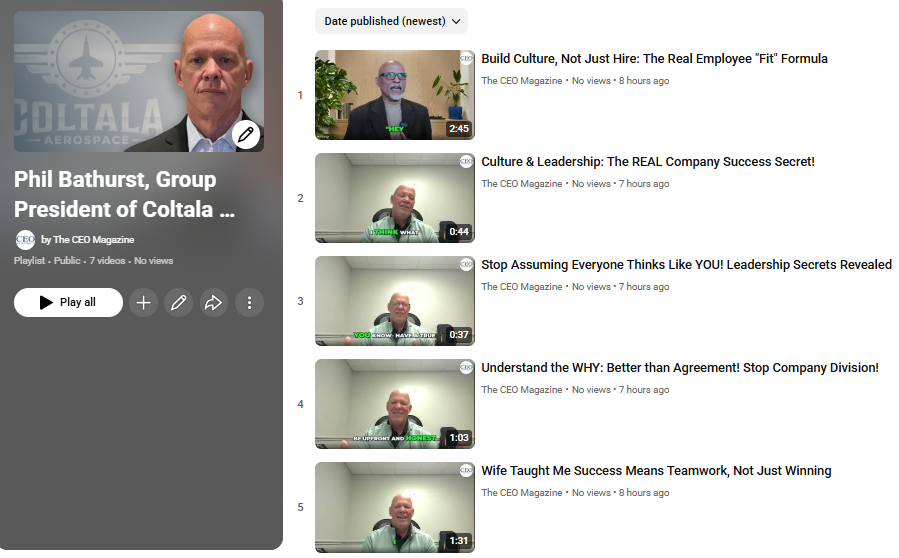
For Video Clips From This Conversation Visit:
Author

Nick Vaidya, MS, MBA, PhD (c)
Website:
www.tptcoach.com
Profile:
www.linkedin.com
Social:
youtube.com/channel/Diagnosis First
Nick Vaidya is a Wiley best-selling author and a regular columnist for The CEO Magazine and Forbes India. He has led the largest center of competence at Dell and served on its chairman’s strategy group. Shaped by experience as Texas A&M System faculty in psychometrics, leading engagements at OC&C Strategy Consultants, and holding CEO/CXO roles in startups, SMBs, and a unicorn, today Nick partners with CEOs to diagnose the latent drivers of performance, bringing a measurement-driven approach to clarity before action.