Executive Summary
In my conversation with Jessica Wescott, three leadership traits stood out: intentionality, balance, and adaptability. Jessica understands that outcomes do not emerge suddenly—they unfold through a chain of cause and effect inside the organization. This insight led to what I call the Outcome Domino:
Individual Attention → Leader Behaviors → Ripple Chains → Final Outcome.
Jessica leads upstream in this chain. Rather than reacting to results after they appear, she focuses on attention and behavior—the earliest points where outcomes are actually shaped. Her leadership reflects a constant effort to balance competing forces across the organization while ensuring that her own preferences do not distort what the situation requires.
Having progressed through the ranks, she has demonstrated a remarkable adaptability by discarding previous identities and adjusting her perspective between operational detail and strategic direction as necessary. During our conversation, she shared a simple line that encapsulates her philosophy:
“Everything’s a data point, not a judgment.”
Jessica Wescott: Leading Through Intentional Balance
What stood out most in my conversation with Jessica was her remarkable intentional awareness about how outcomes actually emerge inside an organization. Many leaders focus on the final result and occasionally glance at a few leading indicators. Jessica thinks differently. She understands that outcomes unfold through what I would call an Outcome Domino—a chain that begins with Individual Attention, moves into Leader Behaviors, creates Ripple Chains, and ultimately produces the Final Outcome.
These ripple chains are not random effects; they are a series of cause-and-effect relationships that move through what can best be understood as a pathmap of the organization. Every action, communication, and decision sends signals through this network. To lead effectively, one must monitor the entire system, rather than solely focusing on the visible outcome at the end. Jessica has a keen awareness of this. She does not merely watch outcomes; she observes how behaviors propagate across the network and shape intermediate results along the way.
In that sense, her leadership is defined by a rare form of intentionality. She understands that goals alone are insufficient. Leaders often set targets and assume execution will follow. Jessica works backward through the causal chain. If the final outcome is revenue growth, profitability, or franchise satisfaction, then there must be intermediate results that produce those outcomes. And those intermediate results depend on the behaviors of leaders and teams. Which means the most fundamental lever is not the outcome itself—it is attention and behavior.
This conversation led me to think about leadership through what I call the Outcome Domino framework. Outcomes fall like dominos through a chain:
Individual Attention → Leader Behaviors → Ripple Chains → Final Outcome
Where a leader directs attention shapes behavior. Behavior creates ripples throughout the organization. Those ripples accumulate into the results we eventually measure. Leaders who only watch the final domino often misunderstand what is actually happening inside the system. Jessica, by contrast, pays attention to the entire cascade.
Such an approach requires something more than strategic thinking. It requires balance.
Jessica seems keenly aware that a CEO’s role is not simply to be a visionary or an operator. It is to regulate the system—to continuously balance competing forces so the right ripples move through the organization. In that sense she functions almost as a Chief Balance Officer. Leaders must push execution while also creating space for collaboration. They must hold people accountable while maintaining trust. They must drive performance without exhausting the system. These tensions rarely resolve themselves; they must be actively managed.
Another thing that stood out about Jessica is how conscious she is about preventing her personal proclivities from distorting the system. Many leaders unknowingly steer organizations toward their own preferences—whether that is analytics, sales, innovation, or operations. Jessica demonstrates a different discipline. She works to ensure that her actions respond to the situational needs of the organization, rather than simply reflecting what she personally enjoys or is most comfortable doing.
In other words, she leads at the intersection of situational demands and personal proclivities. That alignment is difficult. Left unchecked, a leader’s natural tendencies can skew team behavior, distort intermediate results, and ultimately affect final outcomes. Jessica appears deeply aware of this risk and actively regulates it.
Her adaptability is equally striking. Having risen through the ranks—from analyst to CFO, COO, and now CEO—she has repeatedly had to shed prior identities. Each stage of leadership required letting go of what once made her successful. Many leaders struggle with this transition; they remain attached to the competencies that defined their earlier roles. Jessica has demonstrated a willingness to step out of those identities and adopt new ones as the situation demands.
This adaptability shows up in how she manages perspective. Effective CEOs must constantly shift between two views: the microscope and the telescope. The microscope focuses on execution details and operational signals. The telescope focuses on direction, strategy, and long-term positioning. Jessica appears comfortable moving between these perspectives, shifting her attention across different nodes of the organizational pathmap depending on what the moment requires.
Importantly, this awareness does not happen by accident. Jessica is deliberate about creating time and space to reflect. She has built intentional moments into her calendar to step back, assess the system, and ensure her own behaviors remain aligned with the outcomes she seeks to create. This practice may sound simple, but it is one of the most disciplined leadership habits I have seen. Rather than expecting the system to correct itself, she periodically recalibrates her role within it.
There is another subtle leadership behavior that reveals this mindset. Jessica does not expect people to operate the way she once did when she held their roles. Leaders who rise through the ranks often fall into this trap—they assume others should replicate the same path or approach that worked for them. Jessica appears to resist that instinct. She allows leaders to develop their own methods while focusing on the outcomes and behaviors that matter for the system.
Stepping back from the conversation, three qualities stand out.
Intentionality. Balance. Adaptability.
Her intentionality shapes where she directs attention and how she manages behavior. Her sense of balance helps regulate the competing forces that ripple through the organization. And her adaptability allows her to shift perspectives and identities as leadership demands evolve.
Together, these traits reveal a deeper philosophy of leadership. Jessica is not simply managing results. She is managing the cause-and-effect system that produces those results. And in doing so, she demonstrates a rare ability to see leadership not as a position of control, but as the careful regulation of a complex and constantly evolving network.
Reflections
Reflection 1: Outcomes Are Rarely the Place to Lead From
Most leaders watch the final result and react when it moves—revenue numbers, growth targets, or profitability metrics. By the time those indicators shift, however, the forces that produced them have already been set in motion. Jessica’s discipline is to lead several steps upstream. She pays attention to the behaviors, conversations, and signals that precede results. By focusing on the earlier parts of the chain—where attention shapes behavior and behavior creates ripple effects—she is able to influence outcomes long before they become visible on a dashboard.
Reflection 2: Attention Is the First Domino
Where a leader places attention quietly governs what the organization treats as important. Teams watch what the leader notices, asks about, and follows up on. Those signals shape behavior across the system. Jessica appears very aware of this dynamic. Her attention becomes the first domino in a sequence that moves through leader behaviors, team responses, and ripple chains across the organization. Over time, those ripples accumulate into the results the company ultimately produces.
Reflection 3: Leadership Is a Balancing Act, Not a Single Posture
Driving execution too strongly can exhaust the system; leaning too far into vision can detach the organization from reality. Effective leadership requires holding these tensions at the same time rather than resolving them permanently. Jessica’s approach reflects a steady calibration between these forces. In many ways she acts as a regulator of the system, ensuring that the push for performance, collaboration, accountability, and strategic thinking remain in balance.
Reflection 4: Personal Strengths Can Become Organizational Distortions
Leaders naturally gravitate toward what they enjoy or understand best—analytics, operations, strategy, or sales. When unchecked, those preferences can subtly steer the entire organization in that direction. Jessica appears unusually conscious of this risk. Rather than allowing her proclivities to dominate, she focuses on the situational demands of the moment. She aims to ensure that her behavior—and the behaviors it triggers across the team—remain aligned with what the organization actually needs.
Reflection 5: Organizations Behave Like Networks of Cause and Effect
Organizations are not linear machines where one action produces one result. They are networks of cause and effect. Every decision, conversation, and signal moves through a pathmap of relationships, responses, and behaviors. Jessica appears to recognize that leading effectively requires watching this entire network. Rather than treating visible problems as isolated events, she pays attention to how ripple chains move through the system and shape intermediate outcomes along the way.
Reflection 6: Adaptability Requires Shedding Earlier Identities
Jessica’s journey from analyst to CFO, COO, and now CEO required repeatedly letting go of roles that once defined her success. The competencies that make someone exceptional in one position often become constraints in the next. Many leaders struggle with this transition, holding on to the identity that first brought them recognition. Jessica’s rise through the ranks reflects a willingness to shed those earlier identities and adopt the mindset required at each new level of leadership.
Reflection 7: Perspective Shifting Is a Leadership Skill
Effective CEOs must move fluidly between the microscope and the telescope—between operational detail and strategic horizon. One moment requires attention to execution; the next requires stepping back to see the broader system. Jessica appears comfortable making these shifts. She moves her attention across different nodes of the organizational pathmap, focusing on the level of detail that the situation demands.
Reflection 8: Awareness Itself Can Be Designed
Reflection is often treated as an occasional luxury, something leaders hope to find time for after everything else is done. Jessica treats awareness differently. She deliberately creates space in her schedule to step back, observe the system, and recalibrate her attention. By designing moments for reflection, she ensures that her leadership remains intentional rather than reactive—and that the ripple chains moving through the organization remain aligned with the outcomes she intends to create.
Reflection 9: From Leading Individuals to Leading a Leadership System
One of the more subtle shifts Jessica described is the move from leading individuals to leading a team of leaders. Earlier in her career, effectiveness often meant solving problems directly or coaching people one-on-one. As CEO, she realized that this approach limited perspective and slowed execution. By shifting toward collective leadership forums—such as her bi-weekly capability meetings—she created a structure where leaders engage with one another, not just with her. This allows issues to surface from multiple viewpoints and enables the leadership team to move forward together. In doing so, the focus moves from managing individuals to orchestrating a system of leadership that drives the organization forward.
In Closing
“Everything’s a data point, not a judgment.”
In many ways, that single statement captures Jessica Wescott’s leadership philosophy. When leaders treat every signal as data rather than judgment, they remain open, curious, and adaptive. They are less defensive, more aware, and better able to respond to the realities of the system they are leading.
This mindset explains much of what stood out in our conversation—her intentional awareness, her ability to balance competing demands, and her adaptability as a leader who has grown through multiple roles. By viewing situations as information rather than personal verdicts, she is able to stay focused on what the moment requires rather than what personal instinct might prefer.
In a business like franchising—where success depends on aligning the interests of franchise owners, leadership teams, investors, employees, and customers—this mindset becomes even more important. A system with many stakeholders produces constant signals, tensions, and trade-offs. Leading it well requires a steady ability to observe, interpret, and adjust without reacting emotionally or defensively.
Jessica’s approach reflects exactly that discipline. Her awareness of the Outcome Domino, her ability to balance competing forces across the organization, and her willingness to adapt as circumstances evolve all stem from the same underlying principle.
Everything, in the end, is simply a data point—not a judgment.
QUOTES:
- “Everything’s a data point, not a judgment.”
- “Where a leader places attention ultimately shapes behavior across the organization.”
- “You have to allow people to lead in ways that align with their own style and experience.”
- “Leaders naturally lean toward what they are comfortable with—real leadership requires stepping beyond that.”
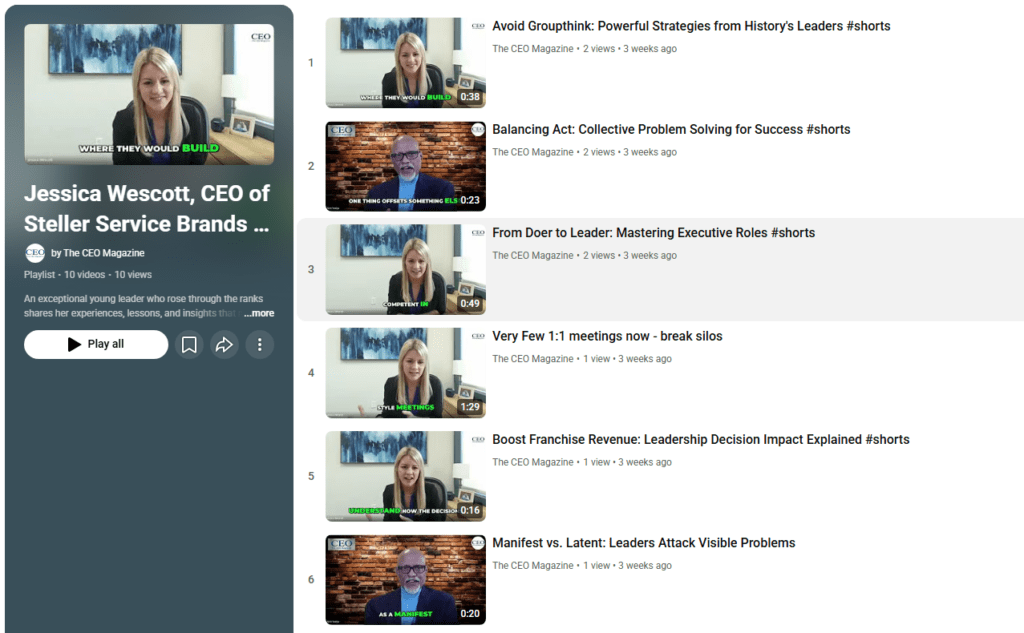
For Video Clips From This Conversation Visit:

Nick Vaidya, MS, MBA, PhD (c)
Profile:
linkedin.com/in/nickvaidya
Social:
youtube.com/the-ceo-magazine
Website:
The-CEO-MAGAZINE.COM
Nick Vaidya is a Wiley Best-Selling author and a regular columnist for Forbes India and The CEO Magazine. He has worn many hats — from University Faculty to CEO/CXO roles across startups, SMBs, and a unicorn — and has also led Strategy and Pricing teams for $8B product line at a Fortune 10 company. Today, Nick helps SME CEOs scale their businesses using his proprietary framework, which focuses on transforming the way meetings are conducted — driving cultural shifts and accelerating organizational growth.