
Executive Summary
A founder-led law firm scaled to more than 500 employees in just a few years, not through marketing intensity or motivational energy, but through structural redesign.
The inflection point was cognitive. For years, productivity meant proximity. Physical presence was a proxy for performance. When distributed work ended that visibility, the firm faced a deeper question: how to define, measure, and reproduce performance without supervision?
The answer was architectural.
Operating cadence was formalized. A COO enforced discipline. Outputs were defined. Throughput and quality were measured. Roles focused on accountability instead of oversight. Training became core infrastructure to reduce variance across locations.
This shift reduced operational complexity. Marketing decisions followed data, not ego, and culture arose from structured loops, not slogans. Within a few years, the firm grew eightfold.
This case highlights a critical principle: leadership often targets the visible, while true scale is driven by less obvious, structural factors. Sustainable growth depends on managing beneath the surface—shifting from surface-level observation to deliberate system design.
Scale is engineered beneath the surface.
The Latent Beneath the Manifest
This reflection is drawn from a conversation with the founder of a law firm that expanded more than eightfold within a few years following a structural redesign of its operating model. What makes the case instructive is not the industry or even the magnitude of growth. It is the cognitive shift that preceded it.
In complex systems, leaders often concentrate on the manifest while remaining insufficiently attentive to the latent. The manifest consists of what is visible: presence, activity, energy, apparent coordination, and surface productivity. These signals are immediate and perceptible. They invite reaction precisely because they can be seen. The latent, by contrast, comprises the structural forces that generate those signals: operating architecture, process design, measurement discipline, incentive alignment, supervisory structure, training rigor, cadence, and trust. These forces are less visible but exert greater influence over performance.
Managers tend to act at the manifest layer. If activity appears low, supervision increases. If alignment seems weak, more meetings are scheduled. If results fluctuate, additional effort is demanded. The implicit assumption is that adjusting what is visible will correct what lies beneath. In complex organizations, that assumption is incomplete. Surface conditions are often expressions rather than drivers.
The turning point in the founder’s thinking came when visibility ceased to provide reassurance. What had previously been interpreted as performance was recognized as a proxy. The deeper question emerged: what, structurally, ensures reliable performance when no one is watching? That shift—from managing what is seen to designing what is unseen—marks the boundary between linear management and nonlinear scale.
Latent drivers are rarely obvious or merely operational. In transformative organizations, decisive drivers tend to exist at structural or psychological levels. A useful analogy can be drawn from Steve Jobs at Apple Inc.. He did not compete primarily by accumulating visible features. Instead, he identified latent drivers—cognitive simplicity, reduced friction, ecosystem coherence, and emotional resonance—and built an architecture around them. The devices were manifestations; the design logic was the engine.
Transformation occurs when leaders identify drivers with disproportionate influence over outcomes and build systems around them. Doing so requires a disciplined causal model—a pathmap. A pathmap is not a dashboard of metrics. It is a structured representation of how latent variables within an organization drive performance. It clarifies leverage points and distinguishes surface motion from structural force. The more nuanced the pathmap, the more precise the intervention; the more precise the intervention, the more predictable the outcome.
In this case, the latent shift was not technological. It was perceptual. Leadership stopped equating visibility with productivity and began redesigning the underlying operating architecture — measurement systems, training cadence, accountability structures, supervisory models, and process discipline. What followed externally as rapid scale was, internally, the compounding effect of structural redesign.

Angel Reyes
Angel Reyes is a leading Texas personal injury attorney and founder of Angel Reyes & Associates. Since 1993, he has built a 650+ employee firm, recovered over $1 billion for clients, earned Texas Super Lawyers recognition (2008–2025), and helped generate 15,000+ five-star Google reviews.

Reflections
The Proximity Illusion — and the Metrics Reveal
For years, leadership assumed visible office activity meant productive work. Proximity inspired confidence. COVID removed that proxy overnight, forcing the firm to confront a deeper question: how to define, measure, and reproduce performance without direct supervision. The response was operational rather than motivational. Outputs were defined, throughput tracked, quality measured, and review cadence formalized. The critical insight was not merely that metrics existed, but that measurement exposed the variance visibility had concealed. Presence had provided reassurance. Measurement provided diagnostic clarity. Control shifted from observation to the system, marking the transition from managing visible activity to engineering the underlying performance architecture.
Operating Infrastructure Was the Real Scaling Move
What appeared externally as rapid scaling was, internally, an architectural redesign. A COO enforced operating cadence and discipline, KPIs were refined, roles shifted toward accountability instead of founder oversight, and structured review loops made team performance legible. Technology enabled the transition through CRM systems, dashboards, and integrated workflows, but the true driver was structural discipline: workflow design, handoffs, throughput management, supervisory ratios, and decision cadence. Management moved from attention-based to architecture-based, making distributed expansion possible without operational entropy. Scale was not an acceleration of effort; it was the consequence of a redesigned operating structure.
Training Was Not Support — It Was Variance Control
Distributed scaling fails first through variance. The firm therefore treated training not as support but as core operating infrastructure: dedicated trainers, structured onboarding, continuous retraining, and leadership pipelines that converted high performers into leads and managers. Measurement exposed deviations; training reduced them. The objective was not isolated competence, but repeatable performance across countries, time zones, and cultural contexts. Scale required variance compression, and training became the mechanism that enabled it.
Focus Simplified Architecture
The firm’s 2019 decision to focus exclusively on auto and truck accidents dramatically reduced operational complexity. Narrowing the scope enabled greater process standardization, which in turn produced clearer metrics, more disciplined training, and ultimately the ability to scale distributed operations with greater consistency. Focus was therefore not merely a strategic choice; it was an architectural simplification that strengthened the entire operating system. Complexity reduction is often the hidden precondition to scalable operational discipline.
Ego Appears as “Brand” — Economics Must Win
In personal injury law, television and billboards often signal not only market dominance but personal status. The firm nevertheless exited those channels and shifted toward digital because performance data justified the move. The decision illustrates how ego can disguise itself as brand strategy and how scaling organizations require the discipline to subordinate identity to economics. The issue was not ego elimination, but consistent deference to ROI over visibility and status.
Culture Emerged from Loops, Not Speeches
Culture was not declared; it was operationalized through clear standards, structured training, measured outputs, feedback loops, and continuous refinement. Subcultures could flourish because the underlying operating backbone remained stable and coherent. Respect was embedded not in slogans but in structure—management ratios, feedback cadence, training systems, and consistent expectations. In this sense, culture did not precede architecture. Culture followed architecture.
From Manifest Control to Latent Design
Within a few years of these structural shifts, the firm expanded approximately eightfold and grew to more than 500 distributed employees operating across multiple countries. What appeared externally as rapid expansion was, internally, the cumulative effect of several perspective corrections: recognizing that presence is not performance, narrowing operational scope to reduce architectural complexity, building operating infrastructure before accelerating scale, institutionalizing training to compress variance, and subordinating ego to economics. The visible growth was manifest; the leverage was structural.
This is not merely a legal-industry story. It illustrates a broader principle of organizational scale: nonlinear growth emerges when leadership identifies the structural drivers with disproportionate influence over outcomes and systematically designs around them. The firm did not scale because it marketed harder or supervised more aggressively. It scaled because it redesigned the underlying operating architecture. Blind spots surfaced, intuition gave way to systems, discipline compounded, and performance became increasingly reproducible.
That is how nonlinear growth is engineered.
QUOTES
- “For years, I mistook proximity for performance.”
- “The org chart isn’t a strategy—the operating system is.”
- “If you want a business, you have to work on it—not in it.”
- “What gets measured gets managed.”
- “You can’t wait for the perfect system. You build the architecture and improve it over time.”
- “What I do is not who I am.”
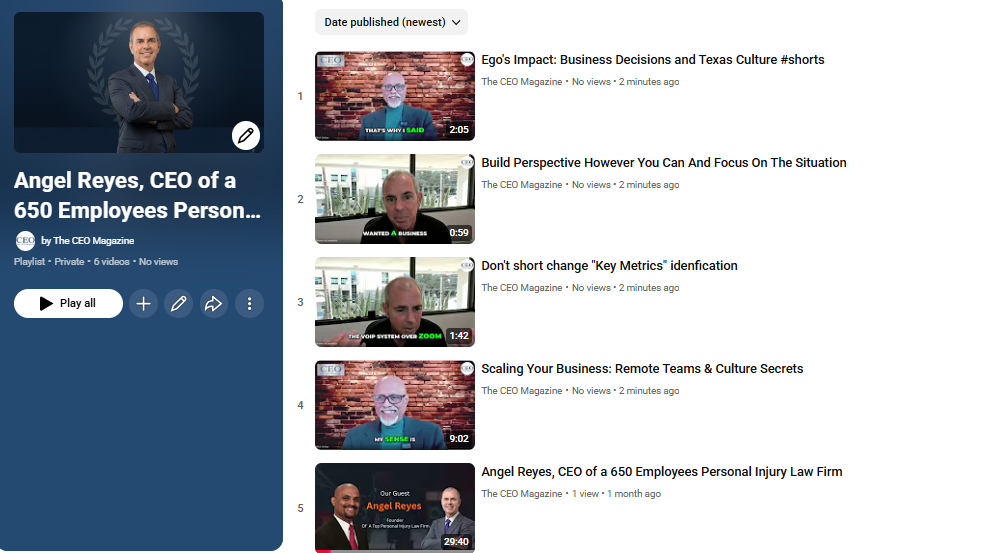
For Video Clips From This Conversation Visit:
Author

Nick Vaidya, MS, MBA, PhD (c)
Website:
www.tptcoach.com
Profile:
www.linkedin.com
Social:
youtube.com/channel/Diagnosis First
Nick Vaidya is a Wiley best-selling author and a regular columnist for The CEO Magazine and Forbes India. He has led the largest center of competence at Dell and served on its chairman’s strategy group. Shaped by experience as Texas A&M System faculty in psychometrics, leading engagements at OC&C Strategy Consultants, and holding CEO/CXO roles in startups, SMBs, and a unicorn, today Nick partners with CEOs to diagnose the latent drivers of performance, bringing a measurement-driven approach to clarity before action.