
CATEGORY: Leadership
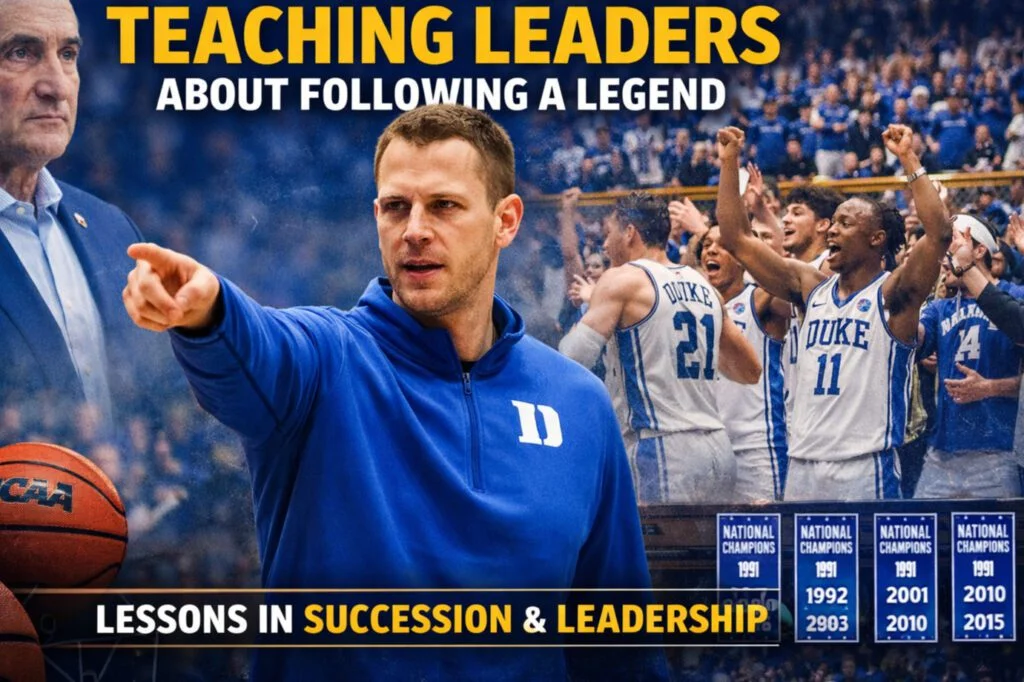
When the Duke Blue Devils men’s basketball beat the North Carolina Tar Heels men’s basketball again recently in college basketball’s most famous rivalry, the story was supposed to be about bragging rights.
Instead, it quietly confirmed something far more remarkable.
With that win, Jon Scheyer became the winningest coach in NCAA Division I history across his first four seasons.
That statistic is impressive on its own. But the context makes it extraordinary.
Scheyer did not inherit an ordinary job. He succeeded Mike Krzyzewski.
For more than four decades, Krzyzewski built Duke into one of the most recognizable institutions in American sports. Five national championships, dozens of NBA players, and a culture of relentless competitiveness turned Cameron Indoor Stadium into something approaching a shrine of college basketball.
Replacing a legendary leader is one of the most difficult assignments in any field. Corporate history is filled with examples of CEOs who followed visionary founders or iconic executives only to find themselves crushed by the expectations that come with the role.
Yet Scheyer’s early tenure has been remarkably steady. Duke remains a national contender as the ACC Championship approaches this weekend and the NCAA tournament begins next week.
For leaders in business, Scheyer’s first four seasons offer a surprisingly clear set of lessons about succession, culture, and credibility.
Culture Is an Inheritance, Not a Costume
One of the most common mistakes successors make is imitation.
When a legendary leader steps down, the temptation is to preserve continuity by performing the predecessor’s style. The new leader copies the cadence, the slogans, the visible habits that defined the previous era.
It rarely works.
Authenticity is difficult to fake, and organizations quickly sense when someone is trying to occupy another person’s identity.
Scheyer understood this from the beginning. The culture of Duke basketball mattered too much to abandon, but it was never going to be sustained through impersonation.
The expectations of discipline, preparation, and competitive toughness remain central to the program. At the same time, Scheyer’s leadership voice feels distinctly his own. His communication style is more conversational. His relationships with players reflect the perspective of someone who played at Duke in the relatively recent past.
The result is continuity without mimicry.
For executives stepping into roles previously held by charismatic founders or transformative CEOs, the lesson is straightforward: culture is something you carry forward, not something you perform.
Credibility Comes From Execution
Successors often feel pressure to prove themselves immediately. That pressure can lead to grand declarations of new strategy, dramatic structural changes, or symbolic attempts to mark a clear break from the past.
Scheyer has taken a different approach.
Rather than announcing a new era, he has allowed credibility to build through performance. Recruiting remains strong. Player development continues to produce NBA-level talent. Duke competes for conference titles and enters March again among the teams capable of making a deep tournament run.
The results speak with more authority than any press conference.
In business leadership, execution plays the same role. Teams rarely judge a new CEO based on opening statements or early speeches. They judge the leader on decisions, discipline, and outcomes over time.
Consistency creates confidence.
Stability Is an Underrated Leadership Skill
Leadership transitions often create internal turbulence.
Employees wonder whether the values that shaped their work will survive the change. Long-standing systems come under review. Informal power structures shift.
In those moments, stability becomes a strategic asset.
Scheyer’s tenure has been notable for the absence of drama. The program’s expectations remain clear. Staff continuity has been strong. Players understand the standards required to succeed at Duke.
That sense of continuity has allowed the team to focus on performance rather than identity.
Corporate leaders face similar moments during transitions. When employees trust that the organization’s core commitments remain intact, energy stays directed toward execution rather than internal uncertainty.
Protecting stability is not passive leadership. It is a deliberate choice.
Following a Legend Requires Perspective
The deeper lesson in Scheyer’s success may be psychological.
Replacing a legendary figure often invites an impossible comparison. The new leader measures every outcome against a career that unfolded over decades.
That comparison can paralyze decision-making.
Scheyer appears to have avoided that trap. His leadership has focused on the next practice, the next game, the next recruiting class. The long arc of Duke basketball remains important, but the daily work of building the program continues without theatrical attempts to redefine the institution.
In leadership terms, this reflects a healthy understanding of stewardship.
A leader who inherits a strong institution is not expected to recreate the past or outshine the founder overnight. The responsibility is to preserve the organization’s mission while guiding it through the present moment.
That work is quieter than the mythology of leadership often suggests.
But it is the work that sustains institutions.
The Real Measure of Succession
Scheyer’s record-setting start will generate headlines, but the larger achievement may be how normal the transition now feels.
The Duke program did not collapse after Krzyzewski retired. It did not drift into years of confusion. It did not spend a decade searching for a new identity.
Instead, it continued.
As the ACC Championship begins this weekend and the NCAA tournament approaches, Duke once again finds itself among the teams competing for a national title.
For business leaders watching from outside the world of college basketball, the lesson is quietly powerful.
The goal of succession is not to replace the legend.
The goal is to carry the mission forward.
Author:

Michael Dunaway
Email:
authors@the-ceo-magazine.com
LinkedIn:
https://www.linkedin.com
Website:
https://www.pastemagazine.com
Michael Dunaway is Editor-at-Large of Paste Magazine, a filmmaker and journalist whose work has appeared in The New York Times, Esquire, Playboy, and The Atlantic.

