
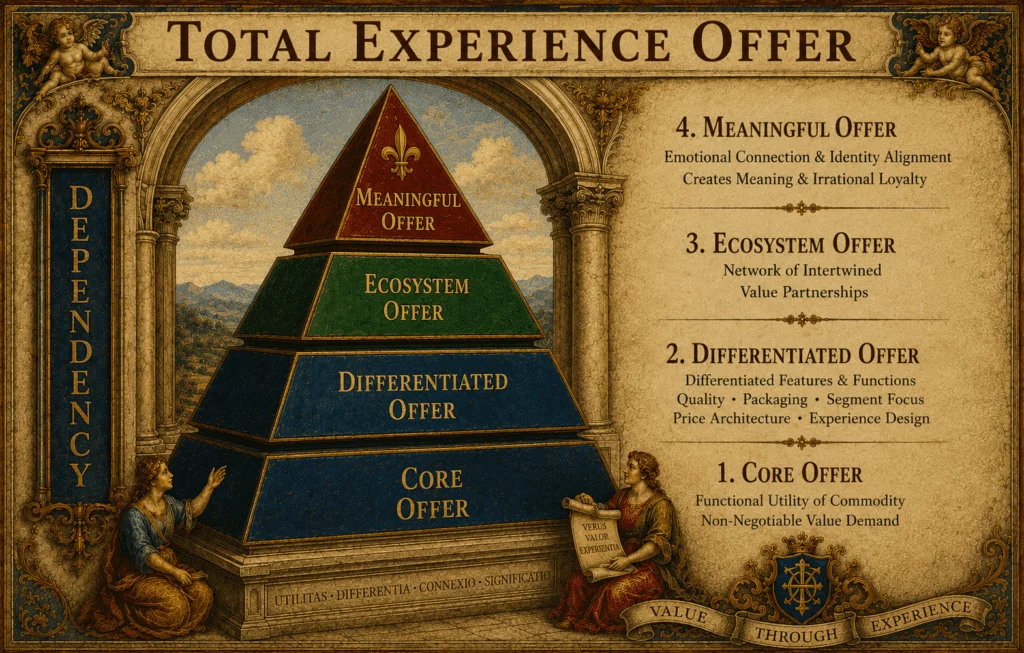
Most companies believe they are selling a product or a service. They define what they do based on the features they provide, the specifications they meet, and the price they charge. But what customers actually buy is almost never the product itself. What they buy is the outcome the product enables, the identity it reinforces, and the experience surrounding it. The gap between what a company offers and what the customer truly values is where the difference lies between a commodity and a high-value, irresistible offer. That gap when filled is what we call the “Total Experience Offer,” or TEO. As we will show you, TEO is possible for a small business just as well as for a Fortune 100 company.
A product in its narrow form is simply the functional component—the immediate utility. But functional utility is not enough to generate differentiation, pricing power, or demand. The Total Experience Offer (TEO) recognizes that customers are not purchasing isolated features. They are purchasing a promise of an outcome and, when possible, emotional resonance: that they will be equipped, guided, and understood to achieve the outcomes and feelings they care about. The value lies not only in what the product does but also in how the entire lived experience around the product contributes to the customer’s sense of meaning and self-expression. People live in a world of feelings and seek emotional support and resonance through their choices.
People certainly buy products for their features, functions, and basic utility. But when given the choice, they prefer offerings that evoke a feeling—one that resonates with their sense of self. And for that, they are often willing to pay a premium.
As I write this, there is a leather-clad chest of drawers in front of me. Its craftsmanship is exquisite: layered textures, precise patterns, and presence. I do not even remember what I kept inside it. Yet I have valued it for decades—not for its function, but for the way it makes me feel each time I notice it. The worth was never in the utility. The worth was in its meaning.
And this concept isn’t limited to large corporations with enormous budgets. It applies just as much to startups and SMBs—whether offering services or products, in B2B or B2C markets. In a competitive market, de-commoditization of your offering becomes inevitable sooner or later; if you don’t proactively differentiate and elevate the experience, you will end up squeezing your margins until you’re drained and exhausted.
Reframing the Question: From “What We Sell” to “What They Experience”
To build a TEO (Total Experience Offer), companies must stop asking, “What are we selling?” and start asking, “How are we helping create a more fulfilling life for our customer?” The moment the frame shifts from product to purpose, the design of the offering changes. The core product becomes just one component of a larger system that includes differentiation features, identity alignment, education, usability, emotional resonance—an entire ecosystem—and the narrative customers tell themselves about the decision. The product becomes part of a relationship, not a transaction.
The Four-Layer TEO Pyramid
A Total Experience Offer can be understood as a simple four-layer pyramid.
At the base is the Core Utility Layer: the essential function or outcome the customer needs. This is the non-negotiable minimum—if the core does not work, nothing else matters.
Above that is the differentiation layer: the differentiating features and performance enhancements that make the product better than the alternatives. These improve convenience, usability, reliability, speed, or efficiency.
The third layer is the ecosystem layer: the network of services, integrations, habits, rituals, partnerships, and communal identity that surrounds the offering and continuously reinforces its value.
The top layer is the Identity & Meaning Layer: the part of the offer that shapes how the customer feels about themselves because they chose your product. This layer is where meaning is created and where true loyalty lives.
Differentiation Requires Focus
Differentiation is impossible without focus. The differentiation layer depends on knowing exactly whom you are designing for. Not the market in general, not “everyone who can use it,” but a clearly defined segment or archetype with shared values, priorities, and emotional drivers. De-commoditization is a natural outcome of choosing a customer identity to align with. When you try to appeal to everyone, you default to the generic middle—and the generic middle is always a commodity. Differentiation only becomes meaningful when it is specific, deliberate, and anchored in the lived reality of the customer you choose to serve.
The differentiation layer is where the offering becomes meaningfully preferable to alternatives through choices in design, experience, positioning, functionality, convenience, aesthetics, or specialization.
reMarkable is a useful example. Technically, tablets like the iPad are vastly more capable devices, and reMarkable is not even significantly cheaper. But reMarkable was not designed for the average tablet user. It was intentionally created for a very specific type of person: someone overwhelmed by digital distraction, craving focus, reflection, and the feeling of thinking clearly again. The company deliberately removed complexity rather than adding more features. Despite competing against companies with infinitely larger ecosystems and more technically advanced products, reMarkable reportedly sold more than a million devices and reached a valuation above a billion dollars. The differentiation was not primarily technical. It was psychological and experiential. reMarkable was selling clarity, intentionality, and a different way to engage with thought itself.
The Ecosystem Layer: From Product to Platform
The Ecosystem Layer is the network of connected products, services, rituals, relationships, integrations, and reinforcing experiences that increase the value of the core offering over time.
The third layer can absolutely be created for almost any product or service. At this level, the product is no longer a standalone object of value. It becomes the center of a broader environment that continuously reinforces engagement, trust, and participation.
Imagine a small accounting firm serving business owners. Initially, the core utility is tax preparation and financial compliance. Better responsiveness, clarity, and strategic advice create differentiation. But over time the firm builds an ecosystem around the client relationship: quarterly business roundtables, benchmarking data across industries, CFO-style dashboards, referral partnerships with attorneys and bankers, leadership workshops, succession planning sessions, curated peer introductions, and an online platform where clients access tools, insights, and educational content. At that point, the client is no longer simply buying accounting services. The firm has become part of the client’s operating system for running the business.
This is where your offering transforms from a product to a platform and from a brand to an environment. The experience expands beyond the moment of purchase into ongoing reinforcement, shared meaning, and co-creation with users, partners, and complementary offerings. The product is surrounded by an ecosystem that continuously renews and compounds its value.
Once a product reaches the ecosystem layer, switching can become emotional and functionally expensive—not because of lock-in, but because the customer’s habits, workflows, relationships, and reinforcing systems now live inside it.
At this level, the company is no longer delivering value alone; it is orchestrating value.
The Identity & Meaning Layer: Where Products Become Symbols
The top of the pyramid—the Identity & Meaning Layer—is where products stop being products and become symbols. This is where customers experience a sense of identity, pride, belonging, aspiration, or self-expression through their choice. Why else would people stand in line at three in the morning outside an Apple store for the release of a new iPhone? They are not waiting for a device. They are participating in a feeling. A moment. It is a story about who they are. At this level, the product is a medium for emotional reinforcement. This stage is where loyalty becomes irrational—and therefore remarkably strong.
Meaning Is the Highest Form of Differentiation
The companies that master this stage do not compete on features. They do not compete on price. They compete on meaning. This is why the most powerful brands in the world do not differentiate primarily through features. They differentiate through the way they make people feel about themselves. The product becomes a medium of identity, belonging, self-expression, mastery, or transformation.
To see the distinction clearly, we only need to look at a few companies that have built their entire success on designing not just what people buy, but who they become when they buy it.
Beyond The Product
The strategic implication is profound. In increasingly competitive markets, functional superiority alone rarely creates enduring advantage. Features are copied. Pricing is matched. Technology diffuses. What becomes difficult to replicate is a deeply integrated experience that aligns utility, differentiation, ecosystem, and meaning into a coherent whole.
Because ultimately, people are not just buying products.
They are buying:
- a feeling,
- an identity,
- a sense of progress,
- a way of life,
- a story about themselves,
- and a deeper sense of meaning through the experiences they choose to participate in.
The product is simply the entry point. The real value often lives in everything surrounding it. Here are some selected examples that demonstrate the idea.
Warby Parker: Democratizing Style Through Choice and Identity
Warby Parker entered one of the most commoditized and mark-up-inflated categories in consumer life: eyeglasses. For decades, a small number of companies controlled design, manufacturing, distribution, and retail. Glasses were treated as medical necessities priced like luxury goods. Warby Parker did not change the product. It changed the structure of meaning around it.
At the Core Layer, Warby Parker delivers what the category requires: durable, well-designed eyeglasses that correct vision reliably. The functional promise is intact and non-negotiable.
At the differentiation layer, Warby Parker redesigned the buying experience. Home Try-On kits, transparent pricing, digital selection, and simplified prescriptions removed the confusion and constraint of traditional optical retail. The differentiator was not breakthrough lens technology. It was removing friction and giving the customer agency.
At the Identity & Meaning Layer, Warby Parker aligned itself with customers who saw themselves as thoughtful, intentional, design-conscious, and expressive without excess. Choosing Warby Parker became a quiet declaration about taste, simplicity, and identity. The frames were not just frames; they became part of the face customers chose for themselves.
At the Ecosystem Layer, Warby Parker moved from product to environment. Retail stores reinforced the brand’s world of books, light, and optimism. Tele-optometry and remote vision tests made ongoing care seamless. Lens replacement programs, social initiatives, and integrated care experiences created continuity beyond the initial purchase. The brand became part of an ongoing cycle rather than a one-time transaction.
Warby Parker did not differentiate by adding more features. It differentiated itself by rewriting the emotional and cultural context of the category.
Starbucks: Turning a Drink into a Place
Starbucks began with coffee beans—a commodity at best, caffeine delivery system at worst. Its genius wasn’t in roasting; it was in ritualizing the experience of drinking coffee. Howard Schultz’s great insight was that people craved belonging as much as caffeine, so the company built a “third place” between home and work, engineered through aroma, sound, lighting, and language. Baristas became hosts. A cup became a moment. That is the essence of a Total Experience Offer: when context becomes content. The product did not fundamentally change. The surrounding meaning did. Starbucks elevated a drink into a ritual, a symbol of pause, familiarity, and identity. Once meaning enters the equation, price stops mattering so much.
IKEA: Democratizing Design
IKEA didn’t win by offering furniture. Furniture was already a commodity—bulky, expensive, and hard to move. IKEA won by transforming the act of furnishing a home into a creative and personal experience.
At the Core Layer, IKEA provides well-designed, functional furniture at prices ordinary people can afford. The baseline utility is solid: the product works, fits, and serves everyday life.
At the differentiation layer, IKEA engineered a system that made that promise scalable: flat-pack design, warehouse-style navigation, self-service selection, and minimalist Scandinavian form. This made quality accessible without requiring luxury budgets. IKEA didn’t just reduce cost—it redesigned the economics of ownership.
At the Identity & Meaning Layer, IKEA turns customers into creators. Assembling furniture may seem like a burden, but IKEA reframed it as authorship. You don’t just buy your home—you build it. Pride and identity are embedded in the outcome: “I made this possible.” IKEA became a symbol of independence, emerging adulthood, and creating a life on your own terms.
At the Ecosystem Layer, IKEA becomes an environment, not merely a store. The curated showroom journey, the cafeteria as a family ritual, the yearly catalog as aspiration engine, the playground that welcomes children, the city-center planning studios, and partnerships around sustainability all reinforce a broader lifestyle system. IKEA is not simply where people buy furniture. It is where they shape the story of their home.
IKEA did not differentiate by adding features. It differentiated by re-designing how people feel about the act of living in a space. You did not just furnish your home; you participated in creating it.
The Pyramid’s Real Wisdom
Identity & Meaning make someone adopt the identity.
The ecosystem makes them live inside it.
Identity & Meaning are the peak of emotional value.
The ecosystem is the peak of structural reinforcement.
You need both to create a deeply resonant brand.
And this can be done for almost any product or service. Most products do not exist in isolation. They are connected to rituals, environments, communities, habits, aesthetics, aspirations, and complementary experiences. The opportunity is often not in changing the core product itself, but in changing the meaning and surrounding experience attached to it.
Coffee cups are largely a commodity. But handcrafted Chinese green tea cups used within traditional tea rituals are something very different. The utility may be similar, but the surrounding experience transforms the meaning entirely. One is a container. The other becomes part of mindfulness, ceremony, identity, aesthetics, and cultural participation.
Harley-Davidson Example
| Layer | Expression |
|---|---|
| Core Utility | Motorcycle works |
| Differentiation | Engine rumble + riding stance |
| Identity & Meaning | “I am free. I am not domesticated.” |
| Ecosystem | Rider clubs, rallies, patches, jackets |
Author

Nick Vaidya, MS, MBA, PhD (c)
Website:
www.tptcoach.com
Profile:
www.linkedin.com
Social:
youtube.com/channel/Diagnosis First
Nick Vaidya is a Wiley best-selling author and a regular columnist for The CEO Magazine and Forbes India. He has led the largest Center of Competence at Dell and worked within the Chairman’s Strategy Team. Shaped by experience as Texas A&M System faculty in psychometrics, leading engagements at OC&C Strategy Consultants, and holding CEO/CXO roles in startups, SMBs, and a unicorn, today Nick partners with CEOs to diagnose the latent drivers of performance, bringing a measurement-driven approach to clarity before action.